Benchmark: AutoCarver vs. optbinning vs. KBinsDiscretizer
This notebook runs the three binning libraries side-by-side on two public datasets:
German Credit — binary classification, mixed numeric / categorical features, 1,000 rows.
California Housing — regression, all-numeric features, 20,640 rows.
For each library and dataset, we report:
``fit`` and ``transform`` wall-clock (seconds)
Downstream-model score — AUC for binary, R² for regression — using a linear model (logistic regression / ridge) on the one-hot-encoded bin output
``train`` → ``test`` score drop as a coarse proxy for drift sensitivity
All three libraries see the same train + dev data and are evaluated on the same held-out test. AutoCarver uses the dev sample for its built-in robustness veto; optbinning and KBinsDiscretizer don’t have a dev-set concept and so treat the union of train + dev as one pooled training set — which is the comparison practitioners actually run.
This is not an IV / Tschuprow’s T leaderboard. Those metrics structurally favour the library whose objective they are. The downstream-model score is the metric a real scorecard team would use to pick a binner.
Numbers come from a single run on a single machine with a fixed seed; treat them as illustrative, not as authoritative benchmark figures. Re-run on your own data before drawing conclusions.
Setup
[1]:
import time
import warnings

import numpy as np
import pandas as pd
import matplotlib.pyplot as plt
from sklearn.datasets import fetch_california_housing, fetch_openml
from sklearn.linear_model import LogisticRegression, Ridge
from sklearn.metrics import r2_score, roc_auc_score
from sklearn.model_selection import train_test_split
from sklearn.preprocessing import KBinsDiscretizer

from AutoCarver import BinaryCarver, ContinuousCarver, Features
from AutoCarver.discretizers.utils.base_discretizer import ProcessingConfig

try:
    from optbinning import ContinuousOptimalBinning, OptimalBinning

    HAS_OPTBINNING = True
except ImportError:
    HAS_OPTBINNING = False
    print('optbinning is not installed \u2014 its rows will be skipped.')

SEED = 42
warnings.filterwarnings('ignore')
plt.rcParams['figure.figsize'] = (10, 3.5)
[2]:
def one_hot(df):
    """Treat every bin label as a categorical level and one-hot encode it.

    Lets a linear downstream model consume any of the three libraries' outputs
    uniformly, without us computing WoE per bin.
    """
    return pd.get_dummies(df.astype(str), drop_first=True).astype(float)


def fit_eval_binary(X_train, X_test, y_train, y_test):
    Xtr = one_hot(X_train)
    Xte = one_hot(X_test).reindex(columns=Xtr.columns, fill_value=0.0)
    model = LogisticRegression(max_iter=1000, random_state=SEED).fit(Xtr, y_train)
    return {
        'train_auc': roc_auc_score(y_train, model.predict_proba(Xtr)[:, 1]),
        'test_auc': roc_auc_score(y_test, model.predict_proba(Xte)[:, 1]),
    }


def fit_eval_regression(X_train, X_test, y_train, y_test):
    Xtr = one_hot(X_train)
    Xte = one_hot(X_test).reindex(columns=Xtr.columns, fill_value=0.0)
    model = Ridge(random_state=SEED).fit(Xtr, y_train)
    return {
        'train_r2': r2_score(y_train, model.predict(Xtr)),
        'test_r2': r2_score(y_test, model.predict(Xte)),
    }


def plot_bars(results_df, score_cols, title):
    fig, axes = plt.subplots(1, len(score_cols), figsize=(4 * len(score_cols), 3.5))
    if len(score_cols) == 1:
        axes = [axes]
    for ax, col in zip(axes, score_cols):
        results_df.plot.bar(x='library', y=col, ax=ax, legend=False, color='#4C72B0')
        ax.set_title(col)
        ax.set_xlabel('')
        ax.tick_params(axis='x', rotation=0)
    fig.suptitle(title)
    fig.tight_layout()
    plt.show()
[ ]:
from AutoCarver.combinations.binary import CramervCombinations

MAX_N_MOD = 5
MIN_FREQ = 0.05

def bin_with_autocarver(X_train, y_train, X_dev, y_dev, X_test, categoricals, quantitatives, kind):
    Carver = BinaryCarver if kind == 'binary' else ContinuousCarver
    features = Features(categoricals=categoricals, numericals=quantitatives)
    config = ProcessingConfig(verbose=False, dropna=False, ordinal_encoding=False)  # showing statistics
    combination_evaluator = CramervCombinations() if kind == 'binary' else None
    carver = Carver(features=features, min_freq=MIN_FREQ, max_n_mod=MAX_N_MOD, config=config,combination_evaluator=combination_evaluator)

    t0 = time.perf_counter()
    X_tr = carver.fit_transform(X_train.copy(), y_train, X_dev=X_dev.copy(), y_dev=y_dev)
    fit_t = time.perf_counter() - t0

    X_dv = carver.transform(X_dev.copy())
    t1 = time.perf_counter()
    X_te = carver.transform(X_test.copy())
    transform_t = time.perf_counter() - t1
    return pd.concat([X_tr, X_dv]), X_te, fit_t, transform_t, carver


def bin_with_optbinning(X_train, y_train, X_dev, y_dev, X_test, categoricals, quantitatives, kind):
    Cls = OptimalBinning if kind == 'binary' else ContinuousOptimalBinning
    X_all = pd.concat([X_train, X_dev])
    y_all = pd.concat([y_train, y_dev])
    binners = {}
    train_binned = pd.DataFrame(index=X_all.index)
    test_binned = pd.DataFrame(index=X_test.index)

    t0 = time.perf_counter()
    for col in X_all.columns:
        dtype = 'categorical' if col in categoricals else 'numerical'
        binner = Cls(name=col, dtype=dtype, min_prebin_size=MIN_FREQ/2, max_n_bins=MAX_N_MOD)
        binner.fit(X_all[col].to_numpy(), y_all.to_numpy())
        binners[col] = binner
        train_binned[col] = binner.transform(X_all[col].to_numpy(), metric='bins')
    fit_t = time.perf_counter() - t0

    t1 = time.perf_counter()
    for col, b in binners.items():
        test_binned[col] = b.transform(X_test[col].to_numpy(), metric='bins')
    transform_t = time.perf_counter() - t1
    return train_binned, test_binned, fit_t, transform_t, binners


def bin_with_kbins(X_train, X_dev, X_test, categoricals, quantitatives, n_bins=5):
    X_all = pd.concat([X_train, X_dev])
    num_train = X_all[quantitatives].apply(lambda c: c.fillna(c.median()))
    num_test = X_test[quantitatives].apply(lambda c: c.fillna(c.median()))
    kbd = KBinsDiscretizer(n_bins=n_bins, encode='ordinal', strategy='quantile')

    t0 = time.perf_counter()
    binned_num_train = pd.DataFrame(
        kbd.fit_transform(num_train), columns=quantitatives, index=X_all.index
    )
    fit_t = time.perf_counter() - t0

    t1 = time.perf_counter()
    binned_num_test = pd.DataFrame(
        kbd.transform(num_test), columns=quantitatives, index=X_test.index
    )
    transform_t = time.perf_counter() - t1

    # KBins has no opinion on categoricals — pass them through as labels
    train = pd.concat([binned_num_train, X_all[categoricals].astype(str)], axis=1)
    test = pd.concat([binned_num_test, X_test[categoricals].astype(str)], axis=1)
    return train, test, fit_t, transform_t, kbd
Binary classification — German Credit
20 features (numeric + categorical), 1,000 rows, target = class == 'bad'. Train / dev / test split = 60 / 20 / 20 %.
[4]:
credit = fetch_openml(data_id=31, as_frame=True)
df = credit.frame.copy()

y_binary = (df['class'] == 'bad').astype(int)
X_binary = df.drop(columns=['class'])

X_train, X_rest, y_train, y_rest = train_test_split(
    X_binary, y_binary, test_size=0.4, random_state=SEED, stratify=y_binary,
)
X_dev, X_test, y_dev, y_test = train_test_split(
    X_rest, y_rest, test_size=0.5, random_state=SEED, stratify=y_rest,
)

categoricals = [c for c in X_binary.columns if X_binary[c].dtype == object or isinstance(X_binary[c].dtype, pd.CategoricalDtype)]
quantitatives = [c for c in X_binary.columns if c not in categoricals]

print(f'train={len(X_train)}, dev={len(X_dev)}, test={len(X_test)}')
print(f'categoricals={len(categoricals)}, numericals={len(quantitatives)}')
print(f'bad rate (train)={y_train.mean():.3f}, (test)={y_test.mean():.3f}')
train=600, dev=200, test=200
categoricals=13, numericals=7
bad rate (train)=0.300, (test)=0.300
[5]:
y_train_full = pd.concat([y_train, y_dev])

runs = [(
    'AutoCarver',
    lambda: bin_with_autocarver(X_train, y_train, X_dev, y_dev, X_test, categoricals, quantitatives, 'binary'),
)]
if HAS_OPTBINNING:
    runs.append((
        'optbinning',
        lambda: bin_with_optbinning(X_train, y_train, X_dev, y_dev, X_test, categoricals, quantitatives, 'binary'),
    ))
runs.append((
    'KBinsDiscretizer',
    lambda: bin_with_kbins(X_train, X_dev, X_test, categoricals, quantitatives),
))

rows = []
for name, run in runs:
    X_tr, X_te, fit_t, transform_t, carver = run()
    scores = fit_eval_binary(X_tr, X_te, y_train_full, y_test)
    rows.append({
        'library': name,
        'fit_s': round(fit_t, 3),
        'transform_s': round(transform_t, 4),
        'train_auc': round(scores['train_auc'], 4),
        'test_auc': round(scores['test_auc'], 4),
        'auc_drop': round(scores['train_auc'] - scores['test_auc'], 4),
    })

binary_results = pd.DataFrame(rows)
binary_results
WARNING: No robust combination for Categorical('own_telephone'). Consider increasing the size of X_dev or dropping the feature (X not representative of X_dev for this feature).
WARNING: No robust combination for Categorical('foreign_worker'). Consider increasing the size of X_dev or dropping the feature (X not representative of X_dev for this feature).
WARNING: No robust combination for Numerical('residence_since'). Consider increasing the size of X_dev or dropping the feature (X not representative of X_dev for this feature).
WARNING: No robust combination for Numerical('existing_credits'). Consider increasing the size of X_dev or dropping the feature (X not representative of X_dev for this feature).
WARNING: No robust combination for Numerical('num_dependents'). Consider increasing the size of X_dev or dropping the feature (X not representative of X_dev for this feature).
[5]:
| library | fit_s | transform_s | train_auc | test_auc | auc_drop | |
|---|---|---|---|---|---|---|
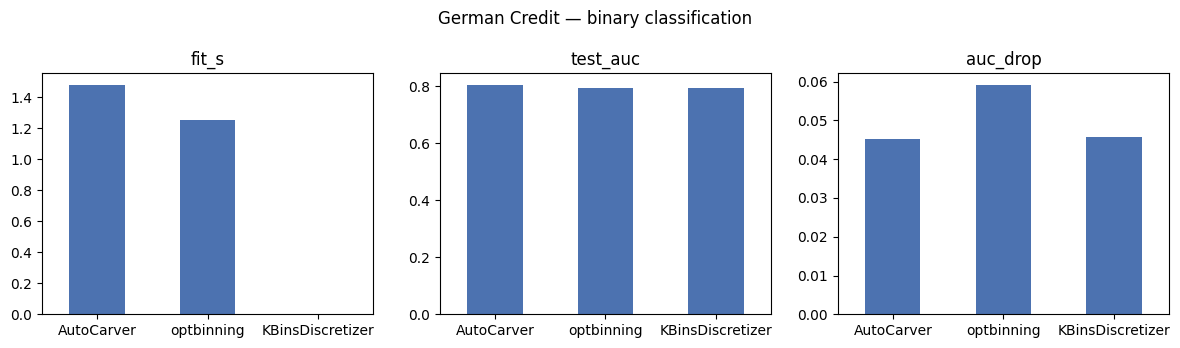
| 0 | AutoCarver | 1.480 | 0.0166 | 0.8496 | 0.8044 | 0.0451 |
| 1 | optbinning | 1.254 | 0.0255 | 0.8523 | 0.7931 | 0.0592 |
| 2 | KBinsDiscretizer | 0.004 | 0.0012 | 0.8401 | 0.7943 | 0.0458 |
[6]:
plot_bars(binary_results, ['fit_s', 'test_auc', 'auc_drop'], 'German Credit \u2014 binary classification')
Regression — California Housing
6 numeric demographic features (Latitude / Longitude dropped — see comment in the next cell), 20,640 rows, target = median house value. Same 60 / 20 / 20 split.
[7]:
housing = fetch_california_housing(as_frame=True)
X_reg = housing.frame.drop(columns=['MedHouseVal'])
y_reg = housing.frame['MedHouseVal']

X_train, X_rest, y_train, y_rest = train_test_split(X_reg, y_reg, test_size=0.4, random_state=SEED)
X_dev, X_test, y_dev, y_test = train_test_split(X_rest, y_rest, test_size=0.5, random_state=SEED)

quantitatives = list(X_reg.columns)
categoricals = []

print(f'train={len(X_train)}, dev={len(X_dev)}, test={len(X_test)}')
print(f'numericals={len(quantitatives)} ({quantitatives})')
train=12384, dev=4128, test=4128
numericals=8 (['MedInc', 'HouseAge', 'AveRooms', 'AveBedrms', 'Population', 'AveOccup', 'Latitude', 'Longitude'])
[8]:
y_train_full = pd.concat([y_train, y_dev])

runs = [(
    'AutoCarver',
    lambda: bin_with_autocarver(X_train, y_train, X_dev, y_dev, X_test, categoricals, quantitatives, 'continuous'),
)]
if HAS_OPTBINNING:
    runs.append((
        'optbinning',
        lambda: bin_with_optbinning(X_train, y_train, X_dev, y_dev, X_test, categoricals, quantitatives, 'continuous'),
    ))
runs.append((
    'KBinsDiscretizer',
    lambda: bin_with_kbins(X_train, X_dev, X_test, categoricals, quantitatives),
))

rows = []
for name, run in runs:
    X_tr, X_te, fit_t, transform_t, carver = run()
    scores = fit_eval_regression(X_tr, X_te, y_train_full, y_test)
    rows.append({
        'library': name,
        'fit_s': round(fit_t, 3),
        'transform_s': round(transform_t, 4),
        'train_r2': round(scores['train_r2'], 4),
        'test_r2': round(scores['test_r2'], 4),
        'r2_drop': round(scores['train_r2'] - scores['test_r2'], 4),
    })

regression_results = pd.DataFrame(rows)
regression_results
[8]:
| library | fit_s | transform_s | train_r2 | test_r2 | r2_drop | |
|---|---|---|---|---|---|---|
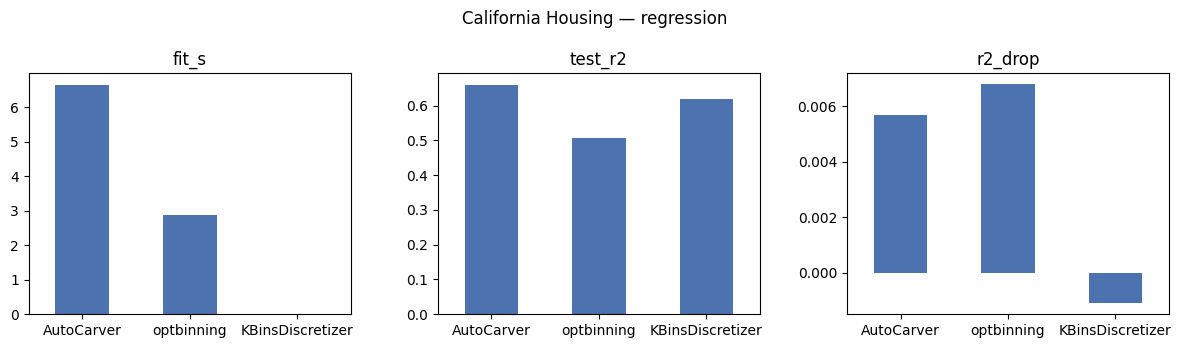
| 0 | AutoCarver | 6.649 | 0.0969 | 0.6652 | 0.6595 | 0.0057 |
| 1 | optbinning | 2.883 | 0.0097 | 0.5145 | 0.5077 | 0.0068 |
| 2 | KBinsDiscretizer | 0.012 | 0.0026 | 0.6181 | 0.6192 | -0.0011 |
[9]:
plot_bars(regression_results, ['fit_s', 'test_r2', 'r2_drop'], 'California Housing \u2014 regression')
How to read these numbers
``fit_s`` / ``transform_s`` measure only
.fit/.transformwall-clock — not data loading, not one-hot encoding, not the downstream model.``test_auc`` / ``test_r2`` are the headline metric. They reflect how well a simple downstream model performs on each library’s binned output. A tree-based downstream model would tell a different (and less binning-sensitive) story.
``auc_drop`` / ``r2_drop`` are
train - testand measure how much each library’s bins overfit. Lower is more robust. AutoCarver’s dev-set veto is designed to keep this small.Same data, same seed, same downstream model across libraries — but a single run, on one machine, with one set of hyper-parameters. Treat as illustrative.
When the result will move
Bigger ``max_n_mod`` / smaller ``min_freq`` will improve AutoCarver and optbinning’s in-sample scores at the cost of
*_drop. KBins doesn’t have a target, so it’s mostly insensitive.Different downstream model. Gradient-boosted trees on the raw features beat any binning + linear pipeline. The point of binning is interpretability, not raw accuracy.
Different dataset. German Credit is small; on a 10M-row credit-risk dataset,
fit_sis what dominates the comparison.
See comparison.rst for the qualitative scope and algorithmic comparison.